news

Stay updated with the latest news and events related to DAL’s activities, including new initiatives, partnerships, and achievements that align with our vision of supporting sustainable development and enhancing positive impact in the community.

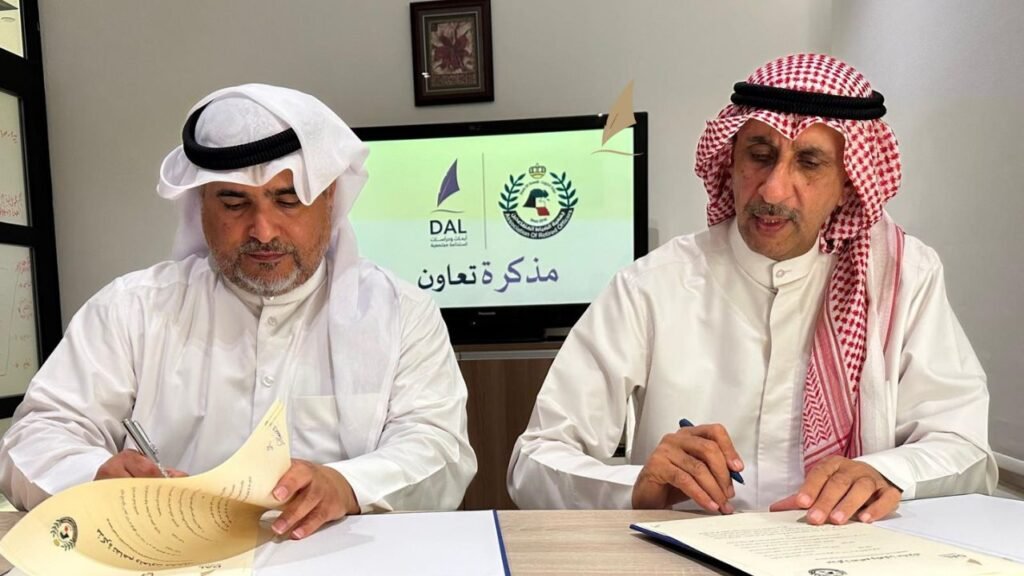
توقيع بروتوكول تعاون بين جمعية الضباط المتقاعدين مع مركز DAL لأبحاث ودراسات الاستدامة المجتمعية

Cooperation Protocol Signed Between Retired Officers Association and DAL for Community Sustainability Research and Studies

A cooperation protocol has been signed between the Retired Officers Association and DAL for Community Sustainability Research and Studies. This follows the acquisition of official approvals from the Ministry of Social Affairs, Family and Childhood Affairs. The agreement aims to strengthen partnerships in the fields of research, studies, and the development of community initiatives. This understanding reflects the commitment of both parties to utilize professional and community expertise for the public good, and to explore new horizons for integrating institutional work with field experience for the benefit of society. The protocol was signed on behalf of the Association by the Chairman of the Board, Major General (Ret.) Faisal Al-Jazzaf, while Dr. Sami Al-Adwani represented DALcs.org.

Governance that Enhances Trust: The Foundation of Sustainability and Institutional Excellence

In the world of non-profit organizations, governance stands out as one of the most important pillars of sustainability and excellence. An institution that adheres to the highest standards of governance and transparency guarantees not only its continuity, but also the trust of the community, partners, and beneficiaries. For this reason, DAL has made “Governance that Enhances Trust” a core part of its strategy for the period 2025-2030. Commitment to governance begins with establishing clear rules and procedures for managing work, distributing responsibilities, and monitoring performance. DAL is keen on building an effective oversight system that ensures service quality, operational efficiency, and enhances the institution’s ability to achieve its objectives effectively. Governance is not merely written regulations, but rather an institutional culture embodied in every decision and action. DAL strives to achieve transparency in all its dealings, starting from announcing plans and programs, through publishing periodic reports, to involving partners and beneficiaries in evaluation and continuous improvement processes. This approach strengthens the institution’s credibility, supports its ability to attract strategic partnerships, and increases the chances of success for community initiatives. DAL attaches special importance to the application of global governance standards (ESG), which focus on environmental, social, and governance aspects. These standards have become an international benchmark for responsible and effective organizations. The institution also seeks to build a culture of internal accountability, ensuring regular performance evaluation and providing feedback for continuous improvement. Governance also means managing risks intelligently, dealing with challenges flexibly, and developing clear policies for crisis management. An institution that adopts sound governance is more capable of adapting to changes and better prepared to face the future with confidence. In the end, governance is not an end in itself, but a means to enhance trust, achieve excellence, and ensure the sustainability of community impact. For this reason, DAL places this pillar at the heart of its strategy and considers it the true guarantee for continuing its mission in serving the community.

Diverse professionals unite for teamwork around a wooden table with laptops and documents.

Weaving Knowledge Networks: Bridges of Collaboration for a Participatory Community

In the information age, knowledge is no longer the preserve of individuals or institutions; it has become an interconnected web of minds, expertise, and experiences. From this perspective, DAL places the pillar of “Weaving Knowledge Networks” at the heart of its strategy, believing that collaboration and networking are the keys to building a participatory knowledge community capable of facing challenges and creating solutions. DAL’s philosophy is that true knowledge is born from interaction among researchers, institutions, thinkers, and decision-makers. For this reason, DAL works to build effective communication bridges through advanced digital platforms, dialogue forums, and workshops that bring various stakeholders together at one table. This networking is not limited to information exchange; it creates a fertile environment for innovation, stimulates collective thinking, and enhances opportunities for collaboration in implementing initiatives and projects. One of DAL’s most important achievements in this field is the development of digital platforms that enable researchers and institutions to share knowledge, document success stories, and provide mutual support. DAL also organizes annual events and knowledge seasons tied to international days, which broaden the circle of influence and strengthen the organization’s presence both locally and internationally. The role of networks is not limited to the knowledge aspect alone, but also extends to building strategic partnerships with associations, organizations, and professional unions. Each link in this network draws strength from the others, and the impact grows as the circle of cooperation expands. DAL believes that building these networks is a long-term investment in social and intellectual capital. The challenge lies in the ability to manage these networks effectively, ensure their sustainability, and continuously develop them. Therefore, DAL relies on the latest digital transformation tools and adopts clear governance policies that guarantee transparency and trust among all parties. In conclusion, weaving knowledge networks is not just an organizational activity, but a work philosophy that DAL believes in and translates into tangible reality, making the community more capable of adaptation, innovation, and achieving sustainable development.
handshake, man, hands, shaking hands, gear, contract, work, trade union, gears, zeitgeist, drive, together, community, transmission, group, industry, collective, mechanics, teamwork, technology, bikes, how works, handshake, shaking hands, shaking hands, shaking hands, contract, contract, contract, contract, contract, trade union, trade union, trade union, trade union

Building Future Competencies: The Cornerstone of Sustainable Community Work

In a rapidly changing world, the need for competencies capable of leading change and making an impact in their communities becomes increasingly prominent. This is why the “Building Future Competencies” pillar is a cornerstone in DAL’s strategy and in any ambitious development system. A knowledge-based society is not only built on generating ideas, but also on having qualified individuals with the skills, vision, and flexibility to face real-world challenges and seize opportunities. The journey of building competencies begins with discovering young talents—those latent energies that need nurturing and guidance. DAL adopts specialized programs to identify research talents, organizes scientific competitions, and establishes research incubators that provide mentoring, networking, and support. These initiatives go beyond theoretical knowledge, focusing on practical training, leadership development, and fostering initiative and teamwork. DAL aims to prepare a generation of community leaders who believe in the values of sustainability, possess critical thinking and decision-making skills, and work with a team spirit. Here, competency is not just an academic certificate, but an integrated system of skills, values, and behaviors that qualify individuals to be effective in their environment and capable of making a real difference. The importance of this pillar lies in the fact that no institution can achieve its goals without the human element. Knowledge alone is not enough unless there are people who carry it and translate it into concrete actions and initiatives. For this reason, DAL places investment in building competencies at the top of its priorities and considers it the true guarantee for sustaining community impact. Perhaps the greatest challenge in this field is keeping pace with rapid changes in the labor market and community needs. Therefore, DAL focuses on developing dynamic and renewable programs that keep up with the latest global trends and respond to the specificity of the local context. It also promotes a culture of continuous learning and supports initiatives that offer youth opportunities for training and self-development. Ultimately, building future competencies is not a choice but a strategic necessity for anyone seeking to create sustainable impact. With qualified leaders, visions become reality and community sustainability becomes an achievable goal.

Scroll to Top